Passing Planning: How to Navigate the "Be Lean, Be Clean, Be Green" Energy Hierarchy
Submitting a planning application for a major residential or commercial development involves meeting complex local sustainability policies. Local Planning Authorities (LPAs) across the UK are increasingly rejecting applications that simply aim for standard baseline Building Regulations.
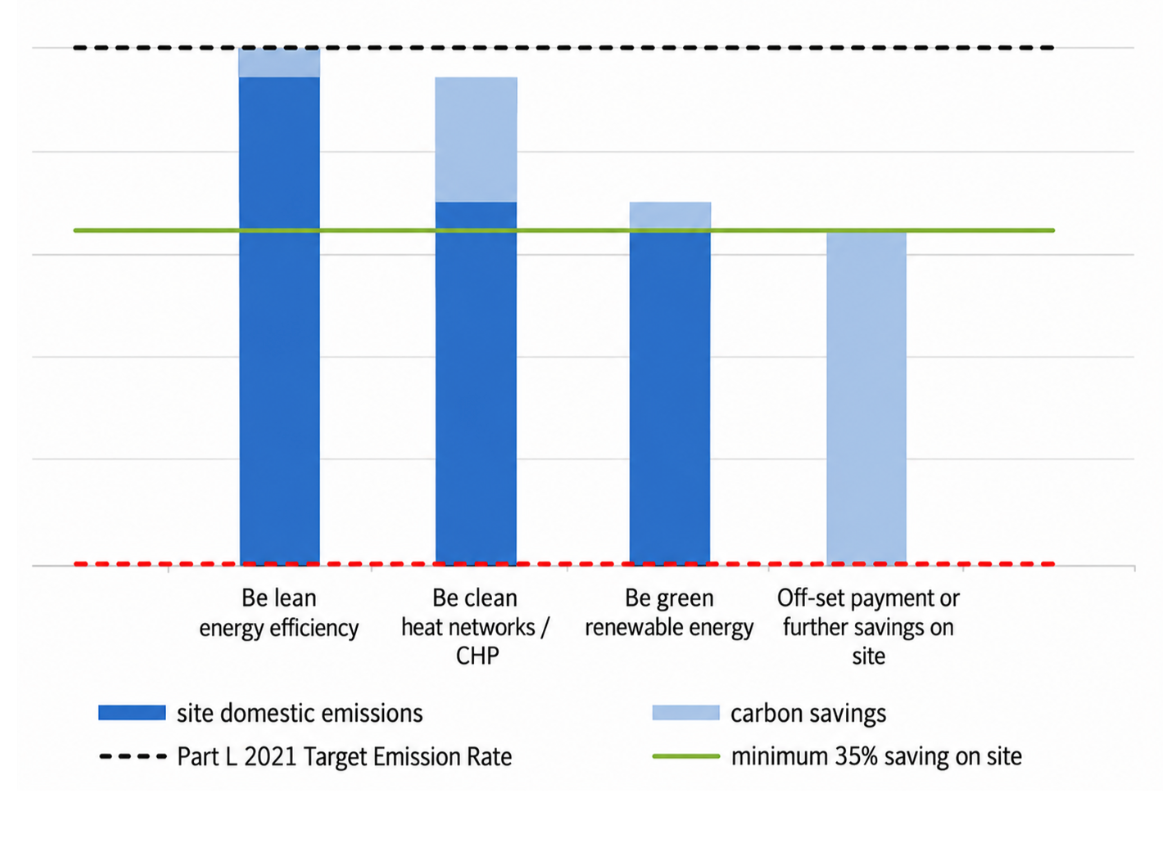
Instead, they require a comprehensive Energy Statement demonstrating how your project will achieve localised carbon reduction targets - often demanding a 35% to 100% reduction in carbon emissions.
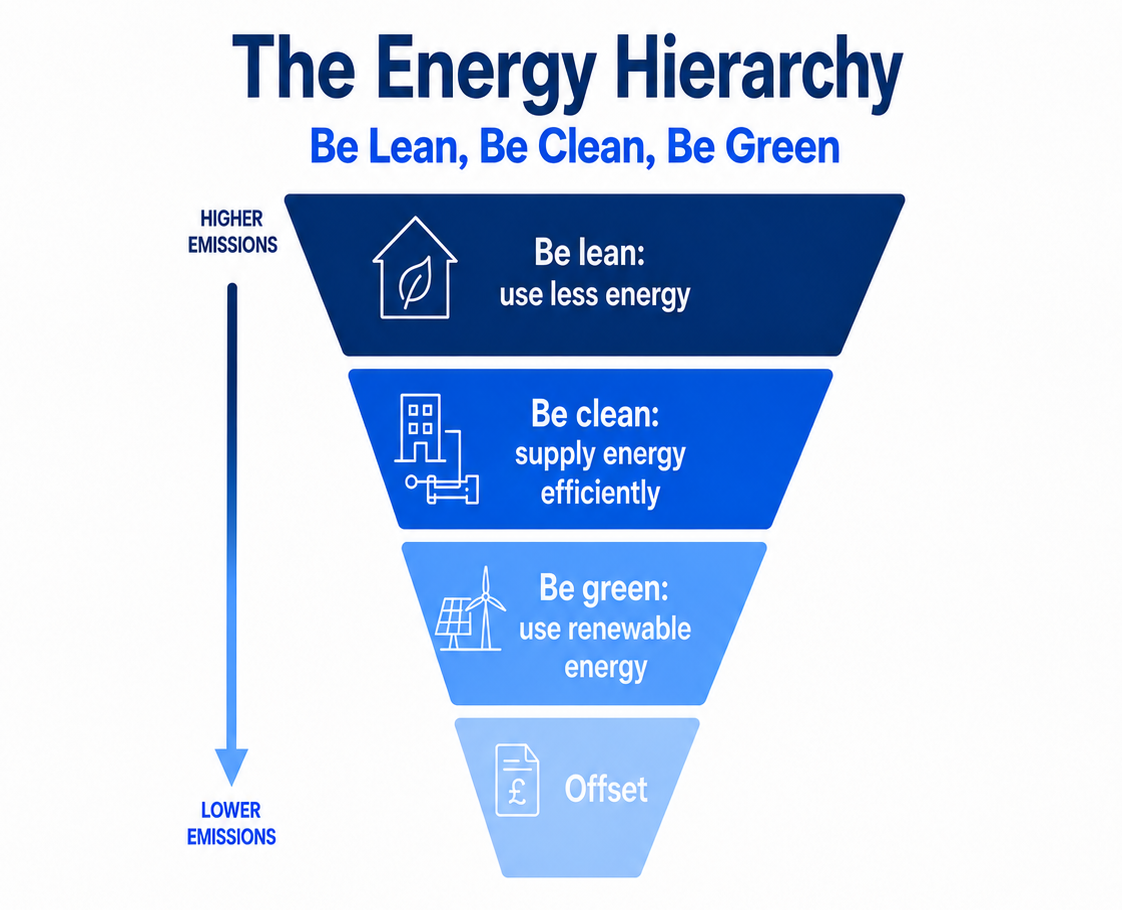
To pass planning without your drawings being sent back to the drawing board, your design must follow the established three-step energy hierarchy:
Step 1: Be Lean (Use Less Energy)
Before adding expensive solar panels, you must minimize the property's baseline energy demand. This is achieved via a fabric-first approach:
- Optimising building orientation to maximise natural daylight.
- Specifying high-performance insulation to drive down U-values.
- Designing out thermal bridging points at structural junctions.
Step 2: Be Clean (Supply Energy Efficiently)
Next, look at how the remaining energy demand is met. This involves utilising highly efficient, low-carbon building services:
- Connecting to localised, decentralised district heating networks where available.
- Specifying heat recovery ventilation systems (MVHR) to capture waste heat.
Step 3: Be Green (Use Renewable Energy)
The final tier requires on-site renewable energy generation to offset remaining emissions:
- Installing solar photovoltaic (PV) arrays on unshaded roof elevations.
- Integrating air-source or ground-source heat pumps.
Beware of the Local Carbon Offset Tax
If your site has physical constraints - such as a historic facade or a shaded urban footprint - and cannot hit the required carbon reduction on-site, you are not entirely out of options. Most LPAs allow developers to pay a Carbon Offset Contribution into a local fund to secure planning approval. However, these cash penalties can cost tens of thousands of pounds.
Engaging an accredited energy consultant before submitting your planning portal documents ensures you strike the right balance between construction costs and compliance.
Ready to unlock your planning approval? Instruct our specialist team to draft your custom Energy Statement.
Achieve Compliance with UKBC
Every project is unique. At UK Building Compliance (UKBC), we don't just provide a report; we provide a strategy to get you to a "pass" at the lowest possible build cost.
- Free Dashpivot App: Simplify your mandatory Part L photographic evidence.
- Expert Technical Support: Bespoke advice on fabric standards and renewable specs.
- Unlimited Design Revisions: We include specification changes in our fee to ensure your project passes.
- Integrated Testing: We coordinate your Air Pressure Testing alongside your SAP reports for a faster sign-off.
Need a SAP calculation for your project? Contact our expert assessors today for a tailored compliance strategy.
Ready to get started?
Get a Quick Quote Online or call our experts today on 01455 242587.